

1. Introduction
Tomato (Solanum lycopersicum L.) is cultivated and consumed extensively worldwide and contains diverse bioactive compounds, including carotenoids (lycopene, β-carotene, and lutein), flavonoids, and phenolic acids (Ali et al., 2021; Bhowmik et al., 2012). These phytochemicals exhibit potent antioxidant properties and can neutralize reactive oxygen species, thereby mitigating oxidative stress (Reboul, 2019). Consequently, regular tomato consumption is associated with a reduced risk of cardiovascular diseases, cancer, and age-related disorders (Reboul, 2019). Among them, lycopene and β-carotene are lipophilic carotenoids whose intestinal absorption and bioavailability are enhanced through micellization when consumed with lipids or alcohol (Van het Hof et al., 2000), suggesting their potential applicability in alcoholic fermented foods.
As tomato juice, paste, and ketchup production has increased, growing quantities of tomato-processed byproducts are increasingly generated. Tomato pomace, consisting mainly of peels, seeds, and fibrous tissues, accounts for approximately 5-7% of the raw material used in tomato processing (Hui et al., 2023). Although generally discarded or used as animal feed, tomato pomace contains abundant carotenoids and phenolic compounds (Tam et al., 2021) as well as dietary fiber, protein, and minerals, while retaining a considerable proportion of its bioactive compounds during processing (Becze et al., 2025). These characteristics make tomato pomace a promising ingredient for the development of value-added foods while supporting the sustainable utilization of food processing byproducts.
Previous studies have shown that tomato pomace can improve the nutritional and functional value of bagels, cookies, pasta, and yogurt by increasing their phenolic compound content and free radical-scavenging potential while maintaining product quality during storage (Kim et al., 2016a; Kim et al., 2016b; Salanta and Farcas, 2024). Collectively, these studies indicate that tomato pomace is a valuable food ingredient that may support both the development of functional foods and sustainable utilization of food processing byproducts.
Makgeolli is a traditional Korean fermented alcoholic beverage produced from cereal grains, nuruk, and yeast via simultaneous saccharification and alcoholic fermentation (Kim et al., 2013). Because it is not distilled, makgeolli retains yeast cells, organic acids, vitamins, amino acids, and various fermentation-derived metabolites, and thus has high nutritional value (Kim and Park, 2019; Seo et al., 2014). Various fruit-, vegetable-, and cereal-based ingredients have been incorporated into makgeolli to enhance its physicochemical and functional attributes. Supplementation with blueberry, omija, red bean, and grape ingredients has been shown to increase the phenolic content and free radical-scavenging capacity of makgeolli and improve its physicochemical quality (Jeon and Lee, 2011; Kim et al., 2012; Song et al., 2015; Ying et al., 2013).
The use of food-processing byproducts in fermented beverages has also expanded. Grape and apple pomace are widely used because their high polyphenol and dietary fiber contents can improve antioxidant activity and nutritional quality (Thomas et al., 2025; Wang et al., 2024). However, little information is available regarding the use of tomato pomace in makgeolli fermentation. In particular, changes in carotenoids and phenolic compounds during fermentation and their contributions to the antioxidant properties of makgeolli have not yet been systematically investigated.
During makgeolli fermentation, the ethanol produced by the yeast may promote the dissolution of lipophilic carotenoids, thereby improving their availability (Becze et al., 2025). In addition, hydrolytic enzymes produced by yeast and microorganisms in nuruk can degrade plant cell walls and release bound phenolic compounds into the fermentation medium. Therefore, tomato pomace was expected to improve the fermentation characteristics and functional properties of makgeolli.
Accordingly, makgeolli samples containing 2, 4, and 8% tomato pomace powder were prepared to evaluate possible changes in fermentation characteristics, bioactive compound contents, and antioxidant activities. The findings of this study highlight the potential of tomato processing byproducts as functional ingredients for the production of traditional fermented alcoholic beverages.
2. Materials and methods
Fully ripened tomatoes, cultivated in Dangjin, Korea, were obtained from an online supplier. Glutinous rice harvested in Goesan, Korea was used as the fermentation substrate for makgeolli. Nuruk (Soyulgok, Songhakgogja, Korea), baker’s yeast (La Parisienne, S. I. Lesaffre, France), and bottled mineral water (Samdasoo, Jeju, Korea) were purchased from the same supplier. Potato dextrose agar (PDA) medium was purchased from Difco Laboratories (Detroit, MI, USA).
Gallic acid, catechin, Folin-Ciocalteu phenol reagent, and 2,2-diphenyl-1-picrylhydrazyl (DPPH), used for total phenolic and total flavonoid analyses, were obtained from Sigma-Aldrich Chemical Co. (St. Louis, MO, USA). 2,2′-Azinobis(3-ethylbenzothiazoline-6-sulfonic acid) diammonium salt (ABTS) was purchased from Fluka Chemical Co. (Buchs, Switzerland). HPLC-grade methanol, ethanol, acetonitrile, and tetrahydrofuran were obtained from Baker Chemical Co. (Phillipsburg, NJ, USA). All other chemicals were of analytical grade unless otherwise indicated.
Fresh tomatoes were rinsed with tap water and cut into approximately 0.5 × 0.5 cm pieces. Tomato juice was extracted using a juicer (H-200, Hanil Co., Daejeon, Korea), and the residual peels and seeds were recovered as tomato pomace. The collected pomace was stored at −75°C for 24 h in an ultra-low-temperature freezer (DF-810, Ilshin Lab Co., Korea) and subsequently lyophilized for 48 h using a freeze dryer (FDU-1200, EYELA Ltd., Tokyo, Japan). After drying, the material was pulverized using a food grinder (Hanil Co.) and sieved twice through a 30-mesh screen to yield a homogeneous powder. The resulting tomato pomace powder was used to prepare makgeolli.
Makgeolli was prepared according to previously described methods, with slight modifications (Kim et al., 2011; Kim et al., 2022). The formulation used in this study was selected based on the results of three preliminary fermentation trials (Table 1). The amounts of water, nuruk, and yeast were calculated based on the weight of the glutinous rice. The control was prepared using 2,000 g of glutinous rice without tomato pomace powder. In the treatment groups, tomato pomace powder was added as a substitute for 2, 4, and 8% (w/w) of the initial glutinous rice weight, corresponding to 40, 80, and 160 g of tomato pomace powder, respectively.
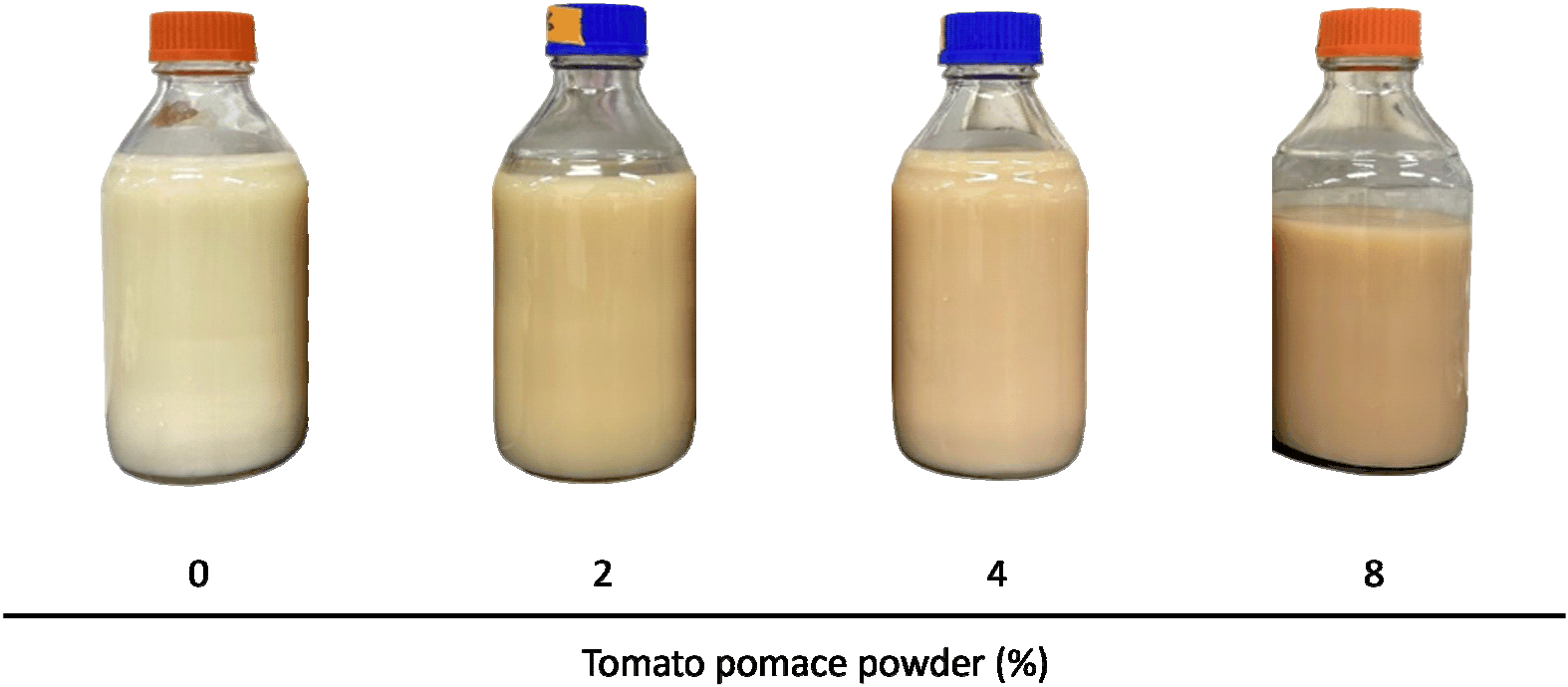
Glutinous rice was rinsed with tap water, immersed in water at 4°C for 12 h, and allowed to drain for 1 h. After steaming at 105°C for 50 min, the cooked rice was cooled to room temperature for 10 min. Steamed rice was blended with water, nuruk, and yeast, followed by the addition of tomato pomace powder at designated levels. The mixtures were homogenized, transferred to fermentation vessels sterilized with boiling water, and incubated at 25°C for 7 days. Representative images of the finished makgeolli samples are shown in Fig. 1. In the primary experiment, a fermentation batch was prepared for each treatment group. Each sample was analyzed in triplicate for all physicochemical and functional analyses (n = 3).
The fermentation characteristics of makgeolli were evaluated by measuring yeast counts, alcohol content, pH, titratable acidity, and soluble solids on fermentation days 0, 1, 3, 5, and 7.
For yeast enumeration, 1 mL of each sample was mixed with 9 mL of sterile diluent to obtain a 10−1 dilution and homogenization for 1 min using a vortex mixer (VM-96A, JEIO Tech Co., Daejeon, Korea). The homogenized samples were serially diluted 10-fold to 10−8. Aliquots (100 μL) of the appropriate dilutions were plated on PDA and incubated at 39°C for 48 h. Yeast populations were subsequently enumerated and expressed as log CFU/mL.
For the alcohol analysis, 100 mL of each filtered sample was mixed with an equal volume of distilled water and subjected to distillation. Approximately 80 mL of the distillate was collected and adjusted to a final volume of 100 mL with distilled water. The alcohol concentration was determined using an alcohol hydrometer, and the readings were corrected to the standard reference temperature of 20°C using a Gay-Lussac table. The final alcohol content was expressed as a percentage (v/v).
Sample pH was measured using a pH meter (Mettler Toledo, Greifensee, Switzerland). Titratable acidity was analyzed using the AOAC (2019) procedure. Briefly, 10 mL of each sample supernatant was titrated with NaOH (0.1 N) until the endpoint (pH 8.3) was reached. Titratable acidity was expressed as a percentage of citric acid equivalents (%). Soluble solids were measured using a digital refractometer (PR-201α, Atago Co., Tokyo, Japan) and expressed as °Brix.
For the analyses of total polyphenol content (TPC), total flavonoid content (TFC), and antioxidant activity, 1 g of each makgeolli sample was combined with 9 mL 70% ethanol and vortexed for 1 min (VM-96A, JEIO Tech Co., Daejeon, Korea). The samples were extracted in an ultrasonic cleaner (Branson Ultrasonics, Danbury, CT, USA) at 40°C for 10 min and then centrifuged at 13,500 ×g for 10 min (Mega 17R; Hanil Co.). The resulting supernatant (2 mL) was mixed with 28 mL 60% ethanol to prepare a 15-fold diluted extract, which was subsequently used for all analyses.
TPC was analyzed using the Folin-Ciocalteu assay described by Singleton and Rossi (1965). The diluted extract (200 μL) was combined with 500 μL of 10% Folin-Ciocalteu reagent and allowed to stand for 3 min before adding 800 μL of 10% sodium carbonate solution. After incubation at room temperature in the dark for 50 min, the absorbance was measured at 750 nm using a microplate reader (Infinite M200 Pro, Tecan Group Ltd., Männedorf, Switzerland). TPC values were obtained from a gallic acid standard curve and reported as μg gallic acid equivalents (GAE)/g.
TFC was determined using the aluminum chloride colorimetric assay described by Woisky and Salatino (1998). An aliquot (100 μL) of the diluted extract was combined with 500 μL of distilled water and 30 μL of 5% sodium nitrite solution. After 6 min, 60 μL of 10% aluminum chloride solution was added, and the mixture was kept in the dark for another 6 min. Subsequently, 200 μL of 1 M sodium hydroxide was added, and absorbance was recorded at 510 nm. TFC was quantified using catechin as the external standard and expressed as μg catechin equivalents (CE)/g.
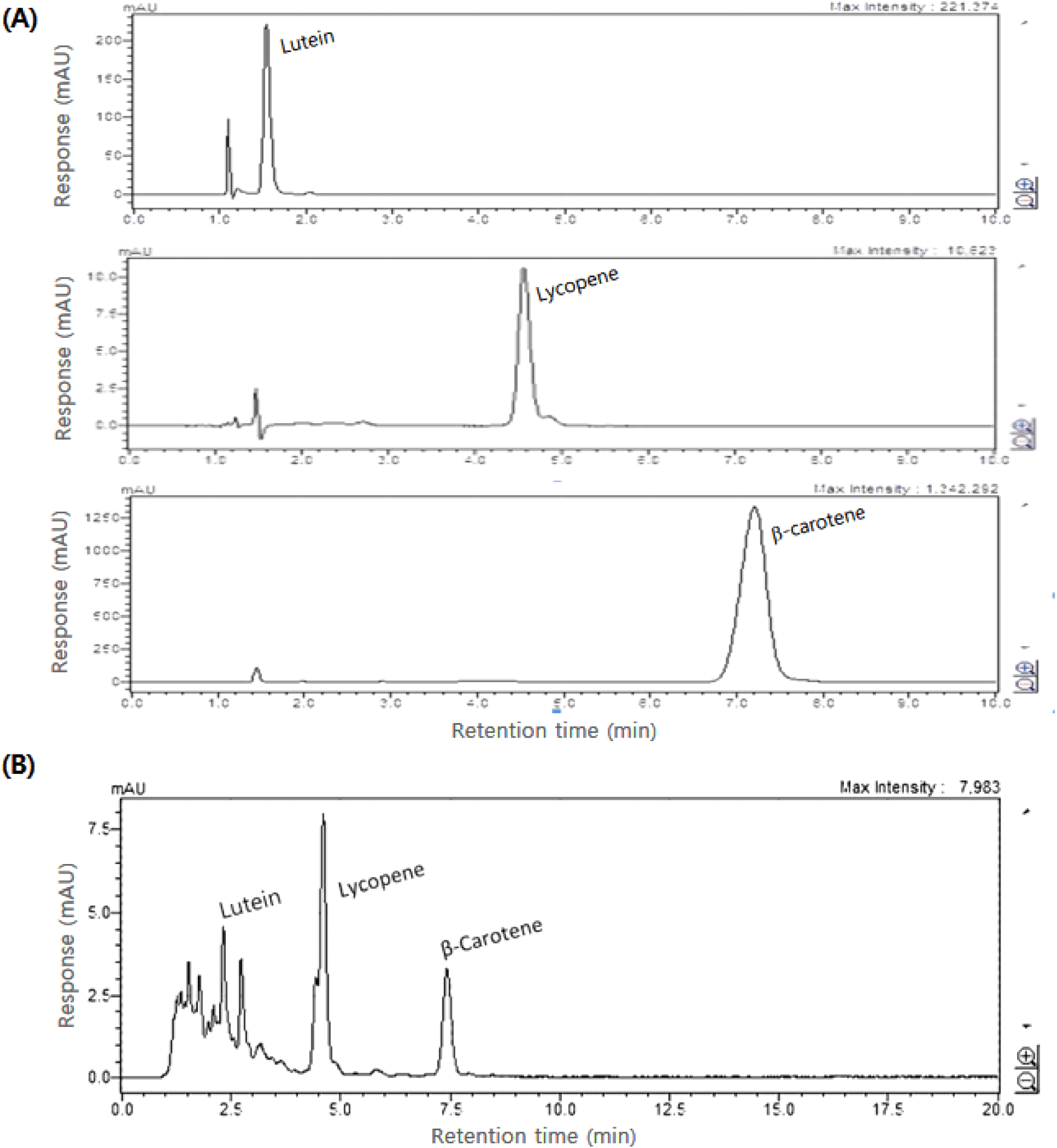
Carotenoids were analyzed following the procedure reported by Hwang et al. (2012). Fermented makgeolli (100 mL) was lyophilized for 48 h (FDU-1200; EYELA Ltd., Tokyo, Japan), pulverized, and sieved twice through a 30-mesh screen. A 1-g portion of the resulting powder was extracted three times, each with 3 mL of ethyl acetate containing butylated hydroxytoluene (100 mg/L). After each extraction, the mixture was centrifuged at 10,000 ×g for 5 min. The resulting supernatants were pooled and concentrated under vacuum. The dried residue was reconstituted in a mixture of 250 μL of diethyl ether and 750 μL of the mobile phase [methanol: acetonitrile:tetrahydrofuran (50:45:5, v/v/v)], passed through a 0.45 μm PVDF membrane filter, and injected into the HPLC system. Separation was achieved on a C18 Nova-Pak column (3.9 × 150 mm, 5 μm; Waters Corp., Milford, MA, USA) maintained at 25°C with the mobile phase delivered at a flow rate of 1.0 mL/min. Detection was performed at 480 nm using a photodiode array detector (SPD-M20A; Shimadzu Co., Kyoto, Japan). Individual carotenoids (lycopene, lutein, and β-carotene) were identified by comparing their retention times with those of authentic standards and quantified using calibration curves prepared using authentic standards. Representative HPLC chromatograms of authentic standards and fermented makgeolli samples are shown in Fig. 2. The contents of lutein, lycopene, and β-carotene were expressed as μg/g of the freeze-dried sample on a dry-weight basis.
DPPH radical-scavenging activity was determined according to the method described by Park and Hwang (2026). The reaction mixture consisted of 768 μL of 0.2 mM DPPH solution (Sigma-Aldrich Co., St. Louis, MO, USA) and 192 μL of the diluted sample. After incubation for 30 min in the dark at room temperature, absorbance was recorded at 517 nm using a microplate reader (Infinite M200 Pro, Tecan Group Ltd., Männedorf, Switzerland). DPPH radical-scavenging activity was calculated as the percentage of inhibition relative to the distilled-water control.
ABTS radical scavenging activity was evaluated using the method described by Re et al. (1999). The ABTS radical working solution was prepared by allowing 7 mM ABTS with 2.45 mM potassium persulfate in the dark for 24 h. The solution was then diluted with 95% ethanol to absorbance of 0.17 ± 0.03 at 734 nm. The assay was initiated by mixing 50 μL of the diluted sample with 950 μL of the ABTS radical solution, followed by incubation in the dark for 10 min. The absorbance was measured at 734 nm, and ABTS radical-scavenging activity was expressed as percentage inhibition relative to the control.
The reducing power was determined according to the method described by Park and Hwang (2026). The diluted sample (250 μL) was combined with 250 μL of 0.2 M phosphate buffer (pH 6.6) and 250 μL of 1% potassium hexacyanoferrate and incubated at 50°C for 20 min. After the addition of 1 mL of 10% trichloroacetic acid, the mixture was centrifuged (1,500 ×g for 10 min). The supernatant (500 μL) was mixed with 500 μL of distilled water and 40 μL of 0.1% ferric chloride. After 10 min, absorbance was recorded at 700 nm using a microplate reader. A higher absorbance indicated greater reducing power.
Data are presented as the mean ± SD from three independent experiments. Statistical analyses were performed using RStudio software (version 3.5.1; RStudio, Boston, MA, USA). Two-way analysis of variance (ANOVA) was used to evaluate the effects of the tomato pomace supplementation level, fermentation time, and their interactions. For parameters measured only at the end of fermentation, differences among the treatment groups were assessed using one-way ANOVA, followed by Duncan’s multiple range test. Statistical significance was set at p < 0.05.
3. Results and discussion
Table 2 summarizes the changes in yeast counts during the fermentation of tomato pomace-supplemented makgeolli. The initial yeast counts ranged from 5.21 to 5.38 log CFU/mL, with no significant differences among treatment groups. In all groups, yeast counts increased until day 3 and then gradually declined during the remainder of the fermentation period (p < 0.05). The yeast count in the control reached a maximum of 9.12 log CFU/mL on day 3 and declined to 7.52 log CFU/mL by day 7. On day 3, yeast counts decreased significantly as the tomato pomace supplementation level increased. The 8% supplementation group had the lowest yeast count (8.21 log CFU/mL) on day 3, which suggests that the tomato pomace may have partially inhibited yeast proliferation.
The initial increase in yeast count reflects the exponential growth phase, during which yeast actively utilizes fermentable sugars, whereas the subsequent decline may result from nutrient depletion and the accumulation of ethanol and organic acids. Similar trends have been reported for red bean- and blueberry-supplemented makgeolli (Ying et al., 2013) and blueberries (Jeon and Lee, 2011). The lower yeast counts in the tomato pomace-supplemented groups may be associated with glycoalkaloids, including α-tomatine and dehydrotomatine, which may interact with sterols in the yeast cell membranes (Hui et al., 2023; Tam et al., 2021). Nevertheless, fermentation proceeded in all treatment groups, which suggests that tomato pomace did not prevent fermentation. Kwon et al. (2012) reported a yeast count of 3.89 log CFU/mL in commercial makgeolli, which was considerably lower than the values obtained in the present study. This difference may be attributable to refrigerated storage after fermentation.
Table 3 summarizes alcohol production during makgeolli fermentation with tomato pomace supplementation. All samples exhibited a rapid increase in alcohol content during the initial fermentation period, followed by a more gradual increase as the fermentation progressed. The control and 2% tomato pomace group reached their maximum alcohol contents on day 5, followed by slight declines to final alcohol contents of 16.43 and 16.53%, respectively. In contrast, the 4 and 8% tomato pomace groups continued to produce alcohol until day 7, reaching significantly higher final alcohol contents of 17.07 and 17.03%, respectively (p < 0.05). This finding suggests that higher tomato pomace supplementation levels may have prolonged the period of alcohol production.
Alcohol is produced through the saccharification of starch by nuruk amylases, followed by yeast fermentation, and is a major determinant of the quality and shelf stability of makgeolli (Kim et al., 2013). Alcohol accumulates rapidly during the initial fermentation phase, reflecting active yeast metabolism.
This subsequent decrease in the rate of alcohol production may be attributed to substrate depletion and ethanol accumulation. The continued alcohol production in the 4 and 8% tomato pomace groups may be associated with residual soluble carbohydrates and dietary fibers in the tomato pomace, which may have provided fermentable substrates. Although yeast counts decreased with increasing tomato pomace supplementation (Table 2), alcohol content increased, suggesting that substrate availability and fermentation efficiency may have had a greater influence on alcohol production than yeast cell number.
Similar fermentation patterns have been reported for makgeolli supplemented with omija (Song et al., 2015), pineapples (Seo et al., 2014), kiwifruits (Kim et al., 2013), and red beans (Ying et al., 2013).
Table 4 summarizes the changes in pH, titratable acidity, and soluble solids during makgeolli fermentation with tomato pomace. Across all treatments, the pH declined markedly during the initial phase of fermentation, followed by either no notable change or a slight increase during the later stages (p < 0.05). The initial pH decreased from 5.76 in the control to 4.57 in the 8% supplementation group. This reduction is likely attributable to naturally occurring organic acids, including citric, malic, ascorbic, and oxalic acids, which are present in tomato pomace (Suarez et al., 2008). The initial decrease in pH was attributed to organic acid production by yeast and lactic acid bacteria during fermentation.
The titratable acidity increased progressively throughout fermentation, with supplemented samples exhibiting significantly higher values than the control (p < 0.05). By day 7, titratable acidity had reached 0.38% in the control and 0.41-0.48% in the tomato pomace-supplemented groups. The higher acidity is likely attributable to the combined effects of the organic acids generated during fermentation and those naturally present in tomato pomace. Similar trends in pH and titratable acidity have also been described for commercial and blueberry-supplemented makgeolli (Jeon and Lee, 2011).
Soluble solids levels increased temporarily on day 1 and gradually decreased thereafter in all groups (p < 0.05), reflecting starch hydrolysis by nuruk amylases, followed by yeast utilization of fermentable sugars (Jeon and Lee, 2011). Although the supplemented groups exhibited slightly lower initial soluble solids content because part of the glutinous rice was replaced with tomato pomace, all groups showed similar fermentation patterns. These results indicate that tomato pomace lowered the initial pH and increased the titratable acidity without adversely affecting sugar utilization or the normal fermentation process.
The changes in TPC and TFC during the fermentation of makgeolli supplemented with tomato pomace powder are presented in Table 5. Tomato pomace contained substantially higher TPC (188.99 μg GAE/g) and TFC (25.22 μg CE/g) than glutinous rice (15.24 μg GAE/g and 9.41 μg CE/g, respectively). Accordingly, the tomato pomace-supplemented groups exhibited significantly higher TPC and TFC values than those of the control group throughout fermentation (p < 0.05), with the highest values observed in the 8% supplementation group.
Regardless of treatment, TPC and TFC increased significantly as fermentation progressed (p < 0.05). The initial TPC ranged from 40.71 μg GAE/g in the control to 83.69 μg GAE/g in the 8% supplementation group and increased continuously to 282.72-331.74 μg GAE/g after 7 days of fermentation. Similarly, TFC increased from 8.50-17.34 μg CE/g at day 0 to 29.47-39.50 μg CE/g at day 7, with the highest values consistently observed in the 8% supplementation group. These results indicated that increasing the level of tomato pomace supplementation effectively enhanced the accumulation of phenolic compounds during fermentation.
The increases in TPC and TFC are likely attributable to the release of phenolic compounds originally present in tomato pomace, together with the degradation of plant cell walls by hydrolytic enzymes produced by yeast and nuruk microorganisms, which facilitate the liberation of bound phenolic compounds. Additionally, ethanol and organic acids generated during fermentation may further promote the extraction of phenolic compounds. Tomatoes contain a diverse range of phenolic constituents, including salicylic, caffeic, and dihydrocaffeic acids, which are mainly concentrated in the peel and seeds (Yamamoto et al., 2014). Collectively, these findings indicate that tomato pomace effectively enriches makgeolli with phenolic bioactive compounds, thereby contributing to the enhanced antioxidant activity observed in this study.
HPLC analysis identified lutein, lycopene, and β-carotene with retention times of 1.50, 4.60, and 7.50 min, respectively (Fig. 2). The carotenoid content of makgeolli supplemented with tomato pomace powder is presented in Table 6. Tomato pomace contained 9.84 μg/g lutein, 315.83 μg/g lycopene, and 14.66 μg/g β-carotene, with lycopene representing the predominant carotenoid. None of these carotenoids was detected in the control makgeolli, whereas all three increased significantly with increasing tomato pomace supplementation (p < 0.05). In particular, lycopene increased from 16.76 μg/g in the 2% supplementation group to 36.15 μg/g in the 8% supplementation group, while lutein and β-carotene increased from 0.01 to 0.52 μg/g and 0.07 to 0.32 μg/g, respectively.
Consistent with the findings of Shao et al. (2013), lycopene was the predominant carotenoid identified in tomato pomace. The proportional increase in carotenoid content with increasing tomato pomace supplementation suggests that tomato pomace is an effective source of carotenoids in makgeolli. The higher carotenoid content observed in the final fermented samples is likely attributable to the increased amount of carotenoids supplied by the tomato pomace. Although the ethanol produced during fermentation may have facilitated the extraction and solubilization of lipophilic carotenoids, this possibility was not directly evaluated in the present study. Therefore, the present results demonstrated that tomato pomace supplementation increased the carotenoid content of the final fermented makgeolli, rather than confirming that fermentation itself enhanced carotenoid availability.
Table 7 summarizes the antioxidant properties of makgeolli supplemented with tomato pomace powder as determined by DPPH and ABTS radical scavenging assays and reducing power. All antioxidant activities increased significantly with fermentation time and tomato pomace supplementation (p < 0.05). The DPPH radical scavenging activity increased from 48.04-62.77% on day 0 to 73.69-77.54% on day 7. Similarly, the ABTS radical scavenging activity increased from 14.34-23.73% on day 0 to 66.71-86.62% on day 7, whereas the reducing power increased from 0.24-0.50 to 0.91-0.94 over the same period. Across all antioxidant assays, tomato pomace supplementation resulted in a significantly greater antioxidant capacity than the control (p < 0.05), with the 8% group consistently showing the highest values.
This improvement in antioxidant capacity can be explained by the high levels of phenolic compounds and carotenoids naturally present in tomato pomace, both of which act as hydrogen- and electron-donating antioxidants. During fermentation, hydrolytic enzymes produced by yeast and nuruk microorganisms may release phenolic compounds associated with plant tissues, whereas the ethanol formed during fermentation may facilitate the extraction of lipophilic carotenoids. Tomatoes are rich in hydroxycinnamic acids, flavonols, rutin, quercetin-3-rutinoside, 5-caffeoylquinic acid, lycopene, and β-carotene, all of which possess potent antioxidant activities (Jung and Hwang, 2021).
The observed increases in antioxidant activities closely paralleled the increases in total phenolic, flavonoid, and carotenoid contents during fermentation, suggesting that increased levels of these bioactive compounds contributed to the enhanced antioxidant capacity of makgeolli. Similar improvements in antioxidant activity following supplementation with tomato-derived ingredients have been reported for yanggaeng (Kim et al., 2014), hwajeon (Jung and Hwang, 2021), and bagels (Kim et al., 2016a). These findings demonstrate that tomato pomace is an effective functional ingredient for improving the antioxidant properties of makgeolli. Although the 8% supplementation produced the highest bioactive compound content and antioxidant activity, the 4% supplementation achieved the highest alcohol content while maintaining comparable antioxidant activity and normal fermentation characteristics. Therefore, among the supplementation levels evaluated in the present study, 4% tomato pomace powder provided a favorable balance between fermentation characteristics and functional properties. However, further studies, including sensory evaluations, are required to determine the optimal supplementation levels for consumer acceptance.
One limitation of the present study is that tomato pomace powder was incorporated by replacing a portion of the glutinous rice rather than by addition to a constant rice formulation. Therefore, the observed effects may reflect the combined influence of tomato pomace powder supplementation and the reduced proportion of glutinous rice. Nevertheless, this formulation represents a practical approach for the development of tomato pomace-fortified makgeolli. Future studies using an addition-based formulation, while maintaining a constant rice content, would help distinguish the individual effects of tomato pomace powder from those associated with rice replacement.
4. Conclusions
Tomato pomace powder, a value-added by-product of tomato processing, was shown to improve the functional properties of makgeolli without adversely affecting the fermentation process. Although tomato pomace slightly suppressed yeast growth, fermentation proceeded successfully, and the 4 and 8% supplementation groups yielded the highest alcohol contents among all groups. The addition of tomato pomace markedly increased the levels of phenolic compounds, flavonoids, and carotenoids, particularly lycopene. These compositional changes were accompanied by greater antioxidant capacity, as demonstrated by DPPH and ABTS assays, together with increased reducing power. These findings demonstrate that tomato pomace is a promising functional ingredient for increasing the bioactive compound content and antioxidant capacity of makgeolli.
Among the tested formulations, 4% tomato pomace powder provided the best overall balance between fermentation characteristics and functional properties, whereas 8% tomato pomace powder yielded the highest levels of bioactive compounds and antioxidant activity. Therefore, supplementation with 4% tomato pomace powder appears to be a suitable approach for producing functional makgeolli while promoting the value-added utilization of tomato processing byproducts.


