

1. Introduction
The global population, currently estimated at 7.3 billion, is projected to surpass 9 billion by 2050. According to the Food and Agriculture Organization of the United Nations (FAO, 2022), meeting the dietary needs of this expanding population will require a approximately 70% increase in food production by 2050, a target that is increasingly difficult to achieve under constraints, such as limited natural resources and arable land. Meat consumption has declined in several high-income countries; however, the global demand continues to increase, driven in part by sustained or rising consumption in emerging economies, such as China, India, and Russia (Chriki and Hocquette, 2020; Rubio et al., 2020). These challenges led to the accelerated search for alternatives, including plant-based meat analogs and products derived from diverse animals and novel sources. However, whether these products can offer a “viable and desirable future,” and for whom and consumer-oriented strategies to support their adoption were not established (Bhat and Fayaz, 2011; van der Weele et al., 2019). Therefore, meat alternatives and products of comparable quality, including cultivated meat, which combines tissue engineering and cell culture to produce muscle for food applications, are being considered (Chodkowska et al., 2022). Additionally, dietary shifts may lower the average meat intake, such as the increased consumption of plant-based meat alternatives (Andreani et al., 2023).
Establishing the full potential of cultivated products requires a responsible food safety approach that builds confidence among regulators, investors, and the public, supported by a clear understanding of the manufacturing processes, potential hazards, and safety requirements (Zhang et al., 2023). Additionally, meat alternatives are innovation-driven niches shaped by diverse sociolegal systems; however, regulatory gaps and uncertainty may hinder technological progress and market development (Ong et al., 2021).
Various methods, including omics-based methods, have been proposed to ensure food safety (Ahn and Kim, 2026; Kim, 2025; Lee et al., 2025). Hazard Analysis and Critical Control Points (HACCP) is a food safety management system for ensuring product safety by proactively identifying potential biological, chemical, and physical hazards throughout the production process and controlling them using established critical process parameters (CPPs) (Awuchi, 2023). However, as a CCP-centered system, HACCP has limited capacity to capture continuous, time-dependent process dynamics, and its implementation is often hindered by difficulties in hazard identification, limited expertise, burdensome monitoring/recordkeeping and documentation, low staff buy-in, and added costs (Eves and Dervisi, 2005).
These capabilities are particularly relevant for plant-based and cultivated meat, where product quality and safety rely on multistage, tightly coupled operations with strong time dependence that are not easily represented by point-in-time checks. This establishes a practical basis for early warning, root-cause traceability, and decision support beyond conventional documentation-centered approaches (Pawar et al., 2023).
The objective of this review is to clarify how data-driven quality management and traceability can be established for plant-based and cultivated meat by integrating sensor-based evidence generation with artificial intelligence (AI)-enabled decision support. The specific objectives are to (i) organize the major manufacturing stages and quality/safety targets of plant-based and cultivated meat; (ii) propose a signal-standardization logic that links measurable signals to CPPs, critical quality attributes (CQAs), and hazard-relevant risk states; and (iii) outline representative Internet of Things (IoT) and AI-based applications that can support monitoring, prediction, early warning, and traceability. Therefore, a structured framework can be established to translate heterogeneous process and quality data into traceability-ready evidence and actionable quality-management outputs.
2. Overview of manufacturing processes and quality and safety targets in plant-based and cultivated meat
Plant-based meat analogs and cultivated meat are produced through multi-stage processes in which quality and safety are determined by operating conditions and their time-dependent trajectories. Accordingly, process-relevant data signals are essential to link manufacturing states to critical quality attributes and potential hazards (Boachie and Aluko, 2025; Barzee et al., 2022). The following process maps link each manufacturing stage to its data-driven monitoring needs based on how stage-specific variables and process histories contribute to quality variation, safety risks, and traceability requirements.
Plant-based meat analogs are typically formulated from plant proteins, lipids, hydrocolloids, flavors, and functional ingredients, and then structured to mimic the texture and appearance of animal meat. A representative workflow includes raw material reception and storage, pre-treatment, blending and formulation, structuring, forming, and cooking or thermal setting, followed by cooling, packaging, and distribution (Benković et al., 2023).
Therefore, not all influential variables should be interpreted as CPPs. Variables that can be directly adjusted during processing, including moisture, mixing temperature, extrusion temperature, screw speed, pressure, shear, cooling conditions, and thermal-setting parameters, are stage-specific CPPs. In contrast, protein composition, particle size distribution, lipid oxidation status, water retention, texture, and shelf-life stability are material attributes, CQA-related outcomes, or quality-relevant contextual factors.
During raw material handling, variability in protein composition, particle size distribution, moisture content, and lipid oxidation status can occur downstream, influencing texture formation and shelf-life stability (Sui et al., 2024). In mixing and hydration, the kinetics of water uptake, dispersion uniformity, and temperature control affect dough rheology and extrusion behavior (Ishaq et al., 2022). Structuring is achieved through high-moisture extrusion to create fibrous textures; it is a key step in which the combined thermal and mechanical profiles drive protein transformation and alignment, leading to phase separation and anisotropic structure formation. Therefore, thermomechanical histories generated during extrusion should be captured as time-dependent sensing trajectories, such as temperature, pressure, shear, torque or load, residence-related behavior, and texture-proxy signals, because they are the basis for downstream AI-based texture prediction, process optimization, and quality control. The final structure, water retention, and texture are affected by subsequent forming and heat treatments, whereas shelf-life changes, such as oxidation, moisture redistribution, and microbial growth, are mainly determined by packaging and cold-chain management (Cornet et al., 2022; Zahari et al., 2022).
Cultivated meat production involves cell culture and tissue engineering principles to generate biomass and, in some approaches, structured tissues (Kirsch et al., 2023). Specific process designs vary; however, a typical manufacturing chain includes cell line selection and banking, media preparation and sterilization, seed train expansion, bioreactor-based proliferation and differentiation, harvesting and separation, structuring and formulation, post-processing, packaging, and distribution (Zhang et al., 2020).
Unlike many conventional food processes, cultivated meat manufacturing is highly sensitive to biological variability and contamination. Cell line stability, media composition, and culture conditions strongly influence growth rate, viability, differentiation efficiency, and compositional outcomes (Lee et al., 2024c). Additionally, the production environment requires a strict hygienic design and validated sanitation procedures owing to the high nutrient content of the media and potential for rapid microbial proliferation during contamination events (Sogore et al., 2024). These unit operations and their corresponding monitoring needs are summarized in Fig. 1, which presents the plant-based and cultivated meat process chains and risk-sensitive control or monitoring points along the process flow.
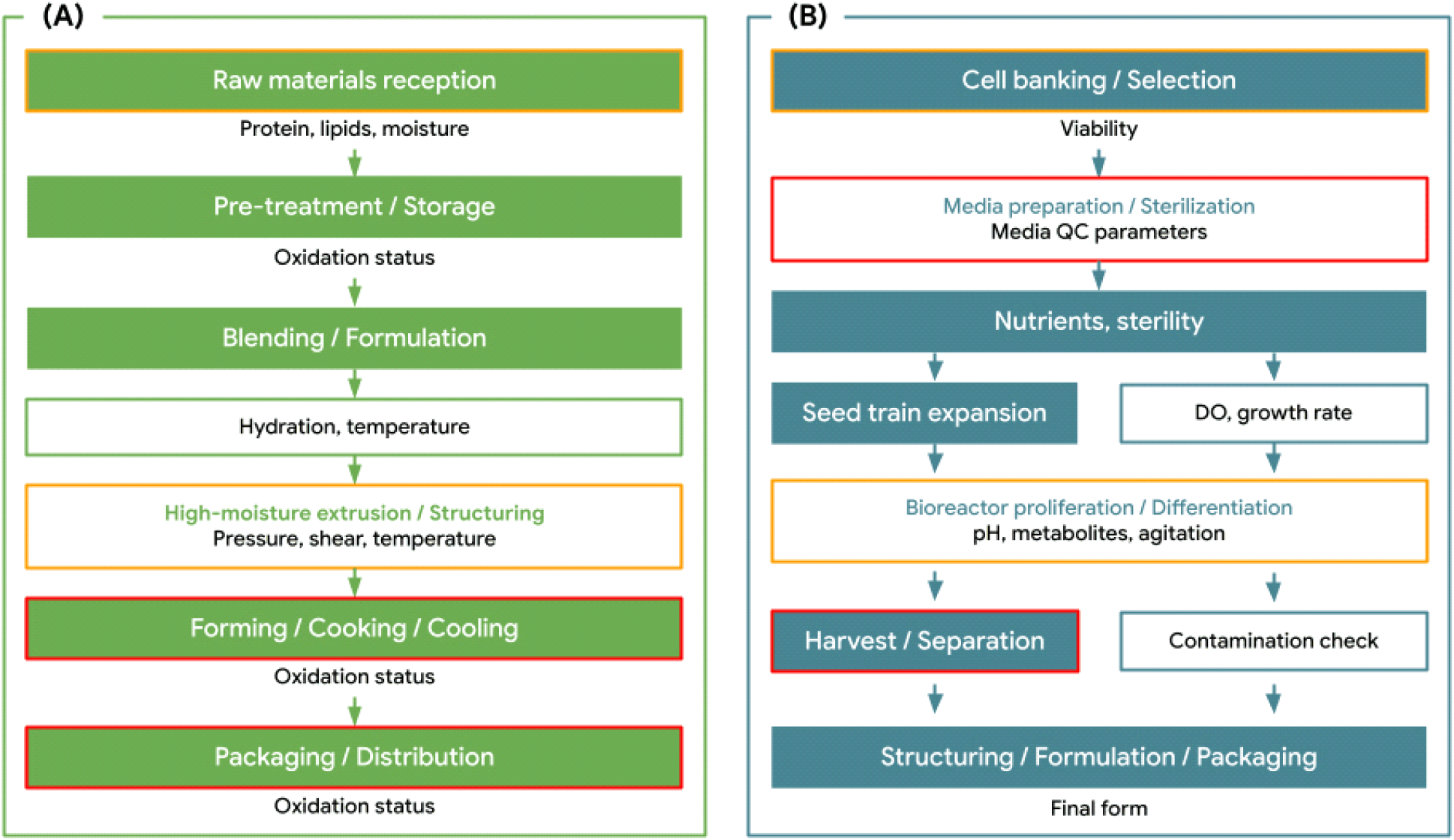
Plant-based and cultivated meats differ in their unit operations and biological complexity; however, both share a common quality-management challenge. Quality and safety are based on time-dependent trajectories and cumulative histories that are not fully captured by point-in-time checks (Zhou et al., 2024). The value of sensor-based monitoring, digital traceability, and AI-enabled analytics for capturing process data is established, supporting quality prediction, and improving traceability across food systems. Therefore, data-driven quality management and traceability are interpreted as an end-to-end capability to (i) acquire high-integrity evidence across batches and stages, (ii) translate multivariate evidence into actionable quality or risk indicators, and (iii) retain auditable records that support root-cause analysis and accountability (Lukacs et al., 2025). Therefore, the framework presented here should be understood as an interpretive synthesis of reported IoT, traceability, and AI applications rather than as an established consensus model.
IoT sensing forms the evidence layer, which is then curated in the data management layer and interpreted in the AI-decision layer to produce traceability-ready quality and risk outputs (Fig. 2). The implementation of IoT- and AI-enabled quality management of plant-based and cultivated meat is more limited by evidence readiness than by model availability. The principal gap is the lack of traceable data, including synchronized timestamps across devices, consistent batch or lot identifiers, and event-linked logs that record changes in set-points and operator interventions. Without disciplined metadata schemes and stable sampling protocols, process histories cannot be reliably reconstructed, deviations in outcomes become difficult to attribute, and the auditability of AI-driven insights is weakened in regulation or quality assurance. This creates a fundamental bottleneck for transparent and reproducible decision-making support across production sites.
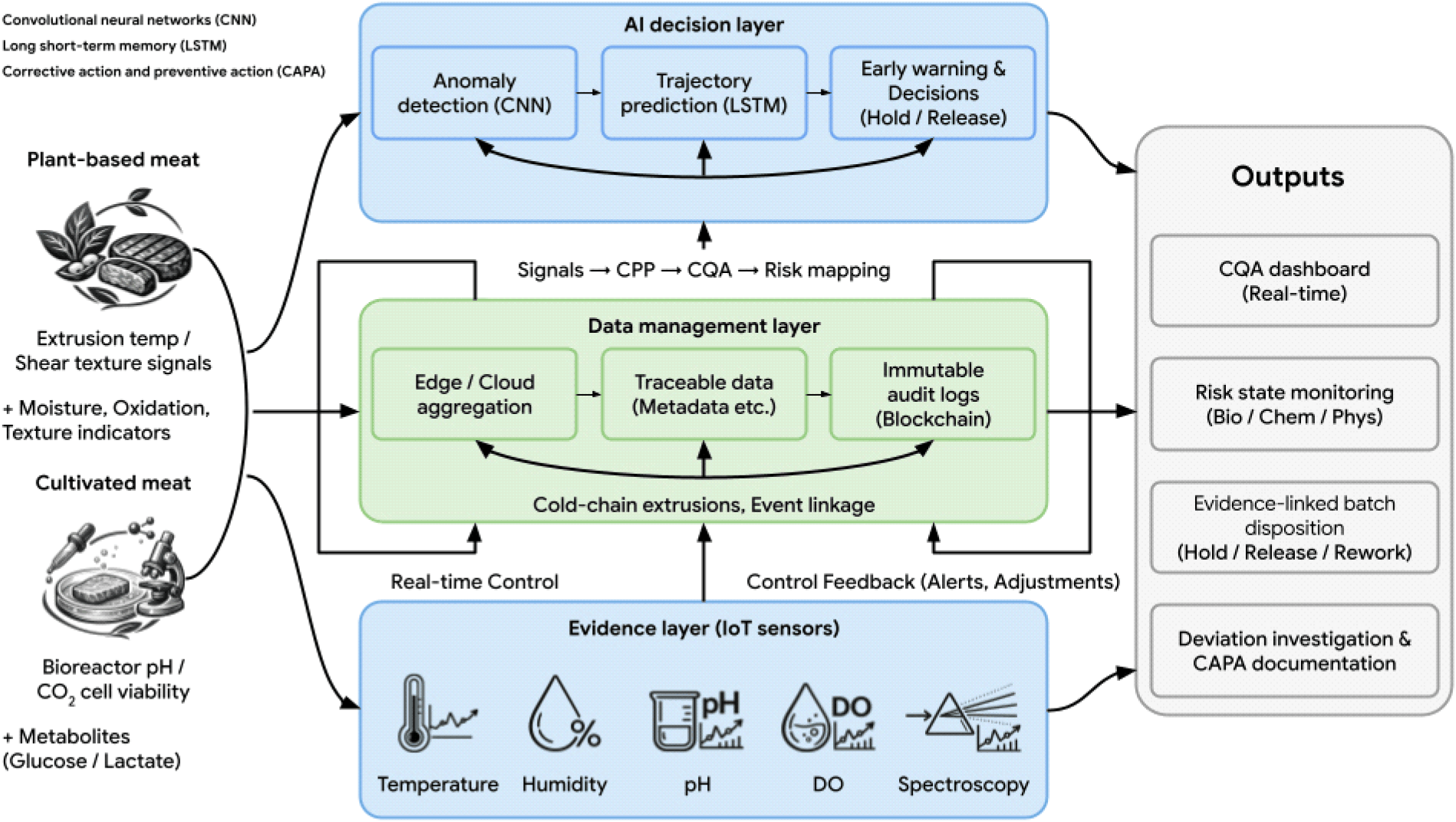
Table 1 summarizes representative IoT and AI use cases that have been reported for conventional meat systems and are transferable as design patterns for plant-based and cultivated meat. Across applications, value is created by isolated measurements and traceability-ready evidence synchronized sensing, standardized identifiers or metadata, and continuous logging that enables event reconstruction and audit-oriented communication. These patterns directly inform data-driven quality management in plant-based processing and cultivated meat manufacturing. However, many studies remain at the pilot stage and may lack external validation, highlighting the need for standardized data governance and verification strategies when translating these approaches to emerging meat-alternative value chains (Gu et al., 2025).
| Application (IoT/AI) | Target | Method | Reference |
|---|---|---|---|
| IoT-based meat freshness classification | Fresh vs. rotten (beef/mutton) | ESP32-CAM images and MQ135/MQ4/MQ136 gas sensors; CNN classifier | Bhuiyan et al. (2024) |
| IoT-enabled blockchain traceability for meat cold-chain logistics | Temperature excursions and auditable end-to-end traceability | Temperature/humidity sensors and GPS/RFID; blockchain logging | Sun et al. (2025a) |
| RFID-based item-level identification for meat traceability | RFID tag readability near meat | UHF RFID and smartphone NFC; Pmin/Rmax benchmarking on packaged minced-meat patties | Barge et al. (2020) |
| IoT-based climate monitoring and control for food processing plants | Food safety and supply-chain visibility or traceability | IoT sensors and real-time monitoring or alerts and EPCIS-based traceability | Kolikipogu et al. (2025) |
| IoT-blockchain provenance system with demand forecasting for meat supply chains | End-to-end provenance or traceability and supply-demand prediction | RFID or barcodes and temperature sensors and GPS; blockchain and GA-optimized LSTM-GRU | Khan et al. (2020) |
| AI-driven drying time prediction for meat products | Drying duration for planning/optimization | ERP and SCADA room data; XGBoost regression and SHAP | Rakholia et al. (2025) |
| Computer vision-based pork marbling assessment for rapid IMF estimation | IMF% | Loin cut images (computer vision) and GBM regression | Chen et al. (2022) |
| AI-based prediction of beef carcass cut yields from abattoir imaging | Grilling and roasting cut yields for carcass valuation or processing | 2D or 3D carcass images (VIA) and ML or DL | Matthews et al. (2022) |
| DL-based separation of spoiled meat in supply chains | Wholesome vs. spoiled red meat | IP camera images; DCNN classifier and PSO tuning | Amani and Sarkodie (2022) |
| Hyperspectral imaging-based meat adulteration quantification | Chicken adulteration level in minced beef (0-50% w/w) | VNIR hyperspectral imaging and PLSR | Kamruzzaman et al. (2016) |
AI, artificial intelligence; CNN, convolutional neural network; DCNN, deep convolutional neural network; DL, deep learning; EPCIS, electronic product code information services; ERP, enterprise resource planning; IMF, intra-muscular fat; IoT, internet of things; GA, genetic algorithm; GBM, gradient boosting machine; GPS, global positioning system; GRU, gated recurrent unit; LSTM, long short-term memory; ML, machine learning; NFC, near-field communication; PLSR, partial least squares regression; PSO, particle swarm optimization; RFID, radio-frequency identification; SCADA, supervisory control and data acquisition; SHAP, shapley additive explanations; UHF, ultra-high frequency; VIA, video image analysis; VNIR, visible and near-infrared; XGBoost, eXtreme gradient boosting; IP, internet protocol.
3. Standardizing measurements: Signals mapped to CQA/CPP and hazards
The signals to measure should be determined through a structured mapping of (i) observable signals to (ii) controllable process parameters, (iii) CQAs, and (iv) hazard-relevant risk states. This section proposes compact standardization logic and stage-wise signal taxonomies for both product categories.
Signal standardization is essential because IoT and AI can only add value when measurements become traceability-ready evidence, that is, time-synchronized streams with consistent identifiers and event linkages that allow an unambiguous reconstruction of events across batches and stages. Similarly, AI performance is substantially constrained by the integrity, consistency, and stability of input signals, making clear signal definitions and standardized measurement practices essential prerequisites for reliable predictions and early warnings (Chapelin et al., 2025; Tolcha et al., 2021).
To standardize measurements, selecting signals that can serve as decision-grade evidence is necessary, not simply collecting more data. A signal is any time-stamped observation from sensors, instruments, imaging, or event logs describing the states of materials, equipment, environment, or operations. A CPP is a controllable operating variable for which change can shift product outcomes (Thiry et al., 2015), whereas CQAs are measurable attributes that define acceptability (Short et al., 2011). Risk states are conditions that increase the likelihood of biological, chemical, or physical hazards or weaken preventive barriers. Instead of assuming a linear one-to-one relationship, this framework organizes multivariate and nonlinear process data to analyze interactions among signals, CPPs, CQAs, and risk states using statistical or AI-based models. In the following subsections, this mapping is applied by grouping signals according to their evidence roles: material-state and process-realization signals mainly support CPP interpretation, outcome-proxy signals support CQA assessment, and barrier-integrity or event signals support hazard-relevant risk identification.
For plant-based meat, measurement standardization is most useful when signals are structured by an evidence role rather than by repeating unit operations. This perspective aligns with the need to relate measurable history to product quality and safety risks in a traceable manner. Material-state signals should capture the input variability that may propagate into the downstream texture, stability, and safety outcomes, including the moisture-related status, functionality-relevant proxies, oxidation-relevant indicators, and storage exposure histories. These signals explain why nominally similar processing yields different structural and shelf-life outcomes. Process-realization signals should be used to establish thermomechanical history because extrusion-based texturization outcomes considerably depend on the coupled temperature-shear-flow regime and its dynamics. Therefore, temperature or pressure profiles, torque or load or energy-related surrogates, and stability indicators are better treated as trajectories than as single-point summaries. Outcome-proxy signals are valuable when they reduce decision latency by providing at-line or in-line indicators of the evolving product state before end-product testing, thus supporting earlier interventions when deviations emerge. Additionally, barrier integrity and event signals provide the discrete evidence needed for accountability and root-cause reconstruction (Chandimali et al., 2025; Hai et al., 2024; Schmid et al., 2022). These categories correspond to practical signal examples summarized in Table 2, such as moisture or volatile indicators, extrusion-related thermomechanical and ultrasound signals, and spectroscopic, e-nose, e-tongue, gas chromatography-mass spectrometry (GC-MS), or ultrasound-derived quality proxies.
| Product/stage | Key signals | Method and purpose | Reference |
|---|---|---|---|
| Plant-based burger / In-line quality monitoring during chilled storage | Portable VNIR hyperspectral reflectance | Portable VNIR-HSI and PCA/PLSR to non-destructively predict key quality attributes | Dhanapal and Erkinbaev (2024) |
| Soybean-based meat analogue / Chilled and frozen storage | E-nose odor fingerprint; HS-SPME-GC-MS volatile markers | In-line odor/volatile profiling to monitor storage deterioration and flag spoilage markers | Sun et al. (2025b) |
| Plant-based beef analogue / Formulation | E-nose odor pattern; E-tongue taste pattern; HS-SPME-GC-MS volatiles | Multi-sensor and GC-MS profiling to monitor flavor/taste shifts and identify key odorants under mycelium fortification | Zhang et al. (2024) |
| High-moisture meat analogue / Extrusion line | Air-coupled ultrasonic transmission: velocity and thickness | Real-time air-coupled ultrasound to monitor texture proxy signals and flag extrusion instability | Guillermic et al. (2023) |
| Pea-protein HMMA / Gas-assisted high-moisture extrusion | Air-coupled ultrasound velocity and attenuation | Non-contact ultrasound to detect bubble formation and infer firmness for rapid QC | Rangira et al. (2026) |
| Cultivated meat / Automated incubation and scheduled media exchange | Online pH; time-stamped media-change events | Automated bioreactor with real-time pH logging to stabilize culture conditions during media refresh | Udomsom et al. (2022) |
| Cultivated meat / In-line bioprocess monitoring | pH; NH4+ | Thread-based microprobe for real-time pH/NH4+ monitoring | Sharma et al. (2023) |
| Cultivated meat / Single-use cell-bag bioreactor | pH; DO; glucose; temperature | Wireless thin-film multi-sensor array for continuous in situ culture monitoring | Lee et al. (2024b) |
| Cultivated meat-relevant bioreactor / Cell cultivation monitoring and thermal control | Temperature; turbidity | ESP32 IoT logging to cloud and Peltier PWM temperature control | Baicu et al. (2024) |
| Cultivated meat-relevant cell expansion / Single-use bioreactor scale-up | In-line capacitance | Online biomass prediction via capacitance and linear regression | Metze et al. (2020) |
DO, dissolved oxygen; HS-SPME-GC-MS, headspace solid-phase microextraction gas chromatography-mass spectrometry; HMMA, high-moisture meat analogue; HSI, hyperspectral imaging; IoT, internet of things; PCA, principal component analysis; PLSR, partial least squares regression; QC, quality control; PWM, pulse-width modulation; VNIR, visible and near-infrared.
Cultivated meat requires a taxonomy that prioritizes biological-state trajectories and contamination-oriented barrier evidence because hazard likelihood and product consistency are dominated by biological variability, aseptic boundary integrity, and time-dependent culture behavior (Gu et al., 2023). Identity and lineage signals should anchor accountability for biological starting materials because phenotypic or genetic drift can accumulate with long-term culturing and undermine reproducibility, even under unchanged nominal controls (Qian et al., 2020).
Culture realization signals should capture established control trajectories together with cell-state observables and intervention logs. Process analytical technology-based in situ spectroscopy enables real-time monitoring of key metabolites and cell density. These measurements can be integrated into control strategies to support trajectory-based process monitoring (Whelan et al., 2012).
Media and boundary-condition signals should include sterility-related evidence and breach-related events because contamination vectors can occur across inputs, equipment, environment, and handling steps; standardized hazard identification and monitoring frameworks explicitly emphasize mapping these hazard sources and their control evidence (FAO, 2022).
Finally, downstream handling and transfer signals should preserve time-temperature exposure, hold durations, and barrier-integrity events through harvest and subsequent operations so that the evidence chain remains continuous from culture history to final quality outcomes and defensible root-cause analysis (Powell et al., 2025). Therefore, the domain-specific value of IoT is based on capturing product- and process-specific evidence, such as thermomechanical histories and texture-related proxies in plant-based meat processing, and culture-state trajectories, sterility evidence, and lineage-linked records in cultivated meat systems.
4. Internet of Things (IoT) and sensor technologies as the evidence layer
IoT-based monitoring in food and farm systems is commonly organized as a multilayer architecture that separates the device, network, data management, and application layers. In the device layer, heterogeneous sensors and identification technologies were used to capture time-stamped observations of products, equipment, and environments during processing and cold-chain operations (Harisha et al., 2024; Verdouw et al., 2019).
Gateways or edge computing units combine data from multiple devices, perform basic filtering or compression, and handle local alarms and security, which reduces bandwidth demands and intermittent connectivity issues in industrial settings (Ficili et al., 2025). Additionally, wired or wireless networks transport streams to cloud-based or on-premise platforms that implement common data models, identifiers, and APIs for downstream quality and traceability applications (Islam et al., 2024).
In the application layer, manufacturing execution system, supervisory control and data acquisition systems, digital HACCP software, and traceability platforms use IoT streams with batch and lot identifiers to generate real-time dashboards, alerts, and compliant electronic records (Boudjenoun et al., 2025). For plant-based and cultivated meats, these layered architectures provide a structural backbone that allows standardized signals and AI-driven analytics to operate on well-structured, traceability-ready data (Arya et al., 2025).
In plant-based and cultivated meat manufacturing, monitoring systems must capture nominal setpoints, time-dependent trajectories, and events that collectively determine quality, safety, and traceability outcomes (Ndraha et al., 2018; Qian et al., 2022). IoT-based monitoring applications can be grouped into a set of recurring system-level patterns: (i) preserving time alignment across heterogeneous signals; (ii) anchoring observations to batch or lot identity and stage context; and (iii) retaining sufficient event-linked evidence for reconstruction and audit-oriented communication (Bai et al., 2023; Manisha et al., 2023). Table 2 summarizes the representative sensor and IoT monitoring cases for plant-based and cultivated meat processing. For example, in plant-based meat processing, air-coupled ultrasound can be used during high-moisture extrusion to monitor texture-related proxy signals and detect extrusion instability, whereas electronic nose or volatile profiling can be used to support storage deterioration monitoring. In cultivated meat systems, in situ pH, dissolved oxygen, glucose, ammonium, temperature, or capacitance sensors can support continuous monitoring of culture-state trajectories, media changes, and biomass growth.
A foundational pattern is batch-anchored continuous monitoring, in which time-synchronized processes and environmental signals are continuously logged with consistent identifiers and metadata. This enables unambiguous reconstruction of the events that occurred within and across stages and establishes a structured dataset for downstream analytics (Adeleke et al., 2023; Alimadani et al., 2025). A second common pattern is equipment-centric process realization monitoring, which captures the established thermomechanical histories beyond set points to explain batch-to-batch variation and detect drift in critical unit operations (Thermo Fisher Scientific, 2025). A third pattern is outcome-proxy monitoring, in which at-line or in-line measurements reduce decision latency by signaling quality deviations before end-product testing is complete (Mattarozzi et al., 2023). In distribution-facing contexts, cold-chain reconstruction monitoring combines condition sensors and identity or location tracking to quantify exposure histories and excursion events that materially impact shelf life and safety (Garrido-López et al., 2025).
Additionally, cultivated meat requires patterns that prioritize biological sensitivity and contamination risk (Rahman et al., 2025). Sterility and barrier integrity monitoring link environmental and equipment boundary evidence to culture history, enabling deviation detection and accountability when contamination occurs. Identity- and lineage-anchored monitoring extends traceability to biological starting materials by logging cell line or bank IDs, passage history, media lots, and intervention records to mitigate drift-related reproducibility failures. Collectively, these patterns define how IoT systems operationalize traceability-ready evidence and provide the necessary substrate for AI-based interpretation and decision support in subsequent layers (Bakhsh et al., 2025; Bell, 2025; Riquelme-Guzmán et al., 2024).
5. AI applications in plant-based and cultivated meat quality and safety management
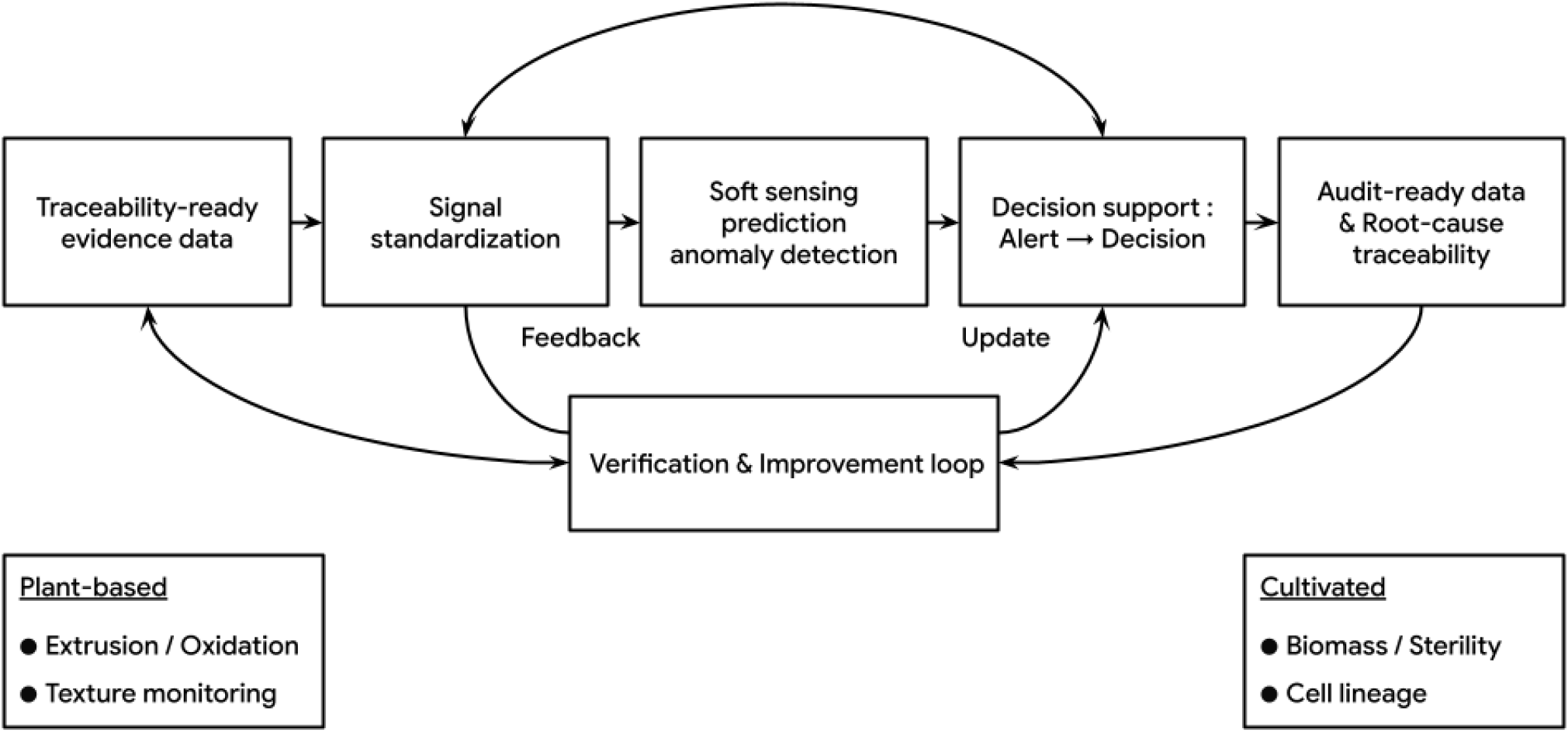
In addition to the evidence layer, AI-enabled analytics include interpretations and decision layers. Fig. 3 illustrates the end-to-end AI analytic loop for decision support. AI is most useful when the outcomes depend on combinations of signals and their temporal patterns, enabling (i) trajectory-based prediction of quality endpoints, (ii) early anomaly detection as a warning before end-product failures occur, and (iii) soft sensing of latent states that are difficult to directly measure. In food manufacturing, these functions are commonly positioned as decision-support-augmenting risk-based controls rather than replacements for established limits, provided that outputs remain traceable to the underlying evidence and support audit-oriented communication (Liakos et al., 2025; Yang et al., 2025). AI functions are the most effective when translating multivariate and time-dependent signals into actionable outputs, including trajectory-based endpoint prediction, early anomaly detection, and decision support for quality monitoring, deviation assessment, and potential process adjustment (Wang et al., 2022).
In plant-based and cultivated meat manufacturing, quality and safety are based on multivariate, often non-linear relationships among formulation, processing, and biological states. Table 3 summarizes representative AI applications across key stages, following recurring patterns of prediction, optimization, and image-based assessment. These applications should be primarily interpreted as quality prediction and process optimization tools, whereas safety-related decision support requires stronger validation, hazard-specific endpoints, and regulatory or industrial verification before use in control decisions.
| Product/stage | Inputs | AI task/model | Decision output | Reference |
|---|---|---|---|---|
| Plant-based meat / Formulation | Proximate composition and target moisture | ML regression | Predicted texture (hardness, chewiness) | Kircali et al. (2023) |
| Plant-based meat / Formulation | Hydrocolloid type, concentration, T and shear rate | ML regression | Predicted viscosity | Lee et al. (2024a) |
| Plant-based meat / High-moisture extrusion | Barrel temp, water content, and cooling-die T | Bayesian optimization | Optimal setpoints for target texture | Jiang et al. (2025) |
| Plant-based meat / High-moisture extrusion | Tannic acid level and moisture content | AI-driven numerical optimization | Optimal TA -moisture for target texture | Gulzar et al. (2025) |
| Plant-based meat / Extrusion | Extrudate images → L*, a*, b*, contrast | BP neural network regression | Predicted texture (hardness, resilience, chewiness) | Wu et al. (2023) |
| Cultivated meat / Culture media formulation | IGF, FGF, TGF, PDGF, selenium, ascorbic acid, serum (%) | RBF neural network and NSGA-II genetic algorithm | Optimal reduced-serum media recipe | Nikkhah et al. (2023) |
| Cultivated meat / Cell expansion | Live cell number and senescence/proliferation biomarkers | RF regression, PCA/K-means, and PLS-DA | Cell quality grade and passage limit | Park et al. (2026) |
| Cultivated meat / Cell culture monitoring | Phase-contrast microscopy images | YOLOv8-seg | Cell-type counts from images | Nabiullina et al. (2025) |
AI, artificial intelligence; BP, back-propagation; FGF, fibroblast growth factor; IGF, insulin-like growth factor; ML, machine learning; NSGA-II, non-dominated sorting genetic algorithm II; PCA, principal component analysis; PDGF, platelet-derived growth factor; PLS-DA, partial least squares discriminant analysis; RBF, radial basis function; RF, random forest; T, temperature; TA, tannic acid; TGF, transforming growth factor; YOLOv8-seg, you only look once version 8 segmentation model.
Kircali et al. (2023) developed a machine learning (ML)-based formulation screening approach for plant-based meat analogs using proximate composition and target moisture to predict texture endpoints. Among the evaluated models, the ridge regression showed the best predictive performance for both attributes. Jiang et al. (2025) applied Bayesian optimization to high-moisture twin-screw extrusion using barrel temperature, water content, and cooling die temperature to reach chicken breast-like mechanical targets with fewer trials than response surface methodology (RSM). Bayesian optimization also delivered lower validation prediction errors. Wu et al. (2023) developed a machine vision and back-propagation neural network model that used extrudate image features to predict texture attributes in pea protein extrusion, enabling rapid, non-destructive quality estimation. The optimized models achieved high correlations between the image features and texture, with genetic algorithm or particle swarm optimization reducing the prediction errors.
Nikkhah et al. (2023) optimized a reduced-serum culture medium for a zebrafish cell line by coupling RSM-designed experiments with radial basis function neural network prediction and non-dominated sorting genetic algorithm II multi-objective optimization to minimize the cost and global warming potential (GWP) and maximize the cell growth rate. The optimized formulations were predicted and experimentally validated to reduce the GWP by ~60-65% and cost by ~20-24% and increase the growth rate by up to ~51% relative to the study’s baseline averages. Park et al. (2026) proposed a passage-based quality-control framework for Hanwoo muscle satellite cells, using proliferation or senescence biomarkers and multivariate classification. Using random forest-based imputation (R2 > 0.93), the cells were stratified into early, intermediate, and late grades to support the passage limit and release decisions. Nabiullina et al. (2025) developed a YOLOv8-seg-based pipeline to detect and count lipoblasts, myogenic cells, and fibroblasts in phase-contrast microscopy images, supporting rapid culture monitoring. Their multiclass model improved the performance to 92% recall, 92% precision, and 81% mAP50, with undercounting in high-density or overlapping cultures.
Collectively, AI applications in meat alternatives are shifting from isolated prediction tasks toward decision-support functions that can be used to reduce experimental burden, shorten quality assessment time, and support process optimization. In plant-based meat processing, ML and optimization models are mainly used to link formulation or extrusion variables with texture, rheology, and visual quality attributes, thereby supporting faster formulation screening and process set-point selection. In cultivated meat systems, AI is more closely associated with biological variability, including media optimization, cell-state classification, passage-related quality control, and image-based culture monitoring. However, most reported applications are study-specific and based on limited datasets, which restricts their transferability across materials, equipment, cell lines, and production sites. Therefore, standardized input signals, external validation, model interpretability, and integration with traceability records should be prioritized in future AI implementation so that predictions can be used as auditable decision-support evidence rather than standalone numerical outputs.
6. Implementation challenges and future perspectives
For plant-based meat, implementation challenges are mainly associated with raw-material variability and complex structuring behavior. Differences in protein source, particle size, moisture content, lipid oxidation, and functional ingredients can strongly affect hydration, extrusion behavior, fibrous structure formation, texture, and shelf-life stability. Therefore, standardized raw-material characterization, real-time thermomechanical history tracking during extrusion, and rapid outcome-proxy measurements, such as texture-, moisture-, oxidation-, or volatile-related indicators, should be prioritized in future monitoring systems.
For cultivated meat, the main limitations are related to the biological variability, contamination risk, and difficulty of maintaining consistent cell quality during scale-up. Cell line stability, passage number, media composition, metabolite accumulation, dissolved oxygen, pH, and aseptic boundary conditions can influence growth, viability, differentiation, and product consistency. Accordingly, lineage-linked records, in situ culture-state monitoring, sterility or barrier-integrity evidence, and validation of sensor-based indicators for release or intervention decisions should be emphasized in future systems.
The second critical challenge is weak standardization and validation. Many datasets and signal definitions remain ad hoc, which reduces cross-site comparability and limits model transfer under drift, sensor replacement, or batch variability. For industrial translation, these limitations should be addressed through cross-site transferability testing, routine sensor drift checks, predefined recalibration criteria, and electronic records that preserve audit trails and links between AI outputs and underlying process data. Near-term progress depends on the establishment of compact stage-relevant signal sets explicitly linked to CPP trajectories, CQA-related proxies, and hazard-relevant risk states. Therefore, thermomechanical histories and early outcome proxies should be prioritized for plant-based processes, whereas lineage or sterility evidence and culture-state trajectories should be emphasized for cultivated meat systems. Therefore, AI systems should be deployed as interpretable decision-support tools with drift monitoring, periodic recalibration, and traceability-linked validation, supported by strong interoperability and governance frameworks to sustain consistency across the end-to-end data chain.
7. Conclusions
A structured understanding of data-driven quality management and traceability was established for plant-based and cultivated meat by integrating IoT-based evidence generation with AI-enabled decision support. The product quality and safety in these emerging meat-alternative systems should not be interpreted through isolated measurements but through cumulative, time-dependent process histories that connect raw materials or biological starting conditions, process realization, product attributes, and hazard-relevant states. By organizing manufacturing stages, monitoring targets, signal categories, sensing technologies, and AI applications, current evidence is used to establish a framework for interpreting heterogeneous process and product data as traceability-ready evidence. The signal-CPP-CQA-risk logic discussed in this review may be a practical basis for linking observable signals to controllable process variables, quality attributes, and risk-related conditions. Additionally, IoT systems serve as an evidence layer that preserves synchronized, batch-linked, and auditable records. AI-enabled analytics may further support predictive and diagnostic interpretation of these records when reliable signal definitions and contextualized data are available. Overall, the significance of IoT and AI in plant-based and cultivated meat production is the digitalization and their potential to support more interpretable, auditable, and timely quality management across complex manufacturing systems. Our study findings contribute to the development of more transparent, reproducible, and responsive production frameworks for next-generation meat alternatives.


